Case study — Restaurant · United Kingdom
Huckleberry's Restaurant
Huckleberry's Restaurant is a UK-based restaurant whose WordPress website needed to earn local search visibility, not just exist. I handled local SEO and on-page optimization, implemented schema markup, and aligned the website with the Google Business Profile so search engines could confirm one consistent identity. The work treated the website as the technical foundation of local search, which is how I approach every restaurant build.
- Role
- WordPress Developer & Local SEO
- Services
- Website Development · Local SEO · Schema Markup
- Stack
- WordPress · Elementor Pro · Schema.org
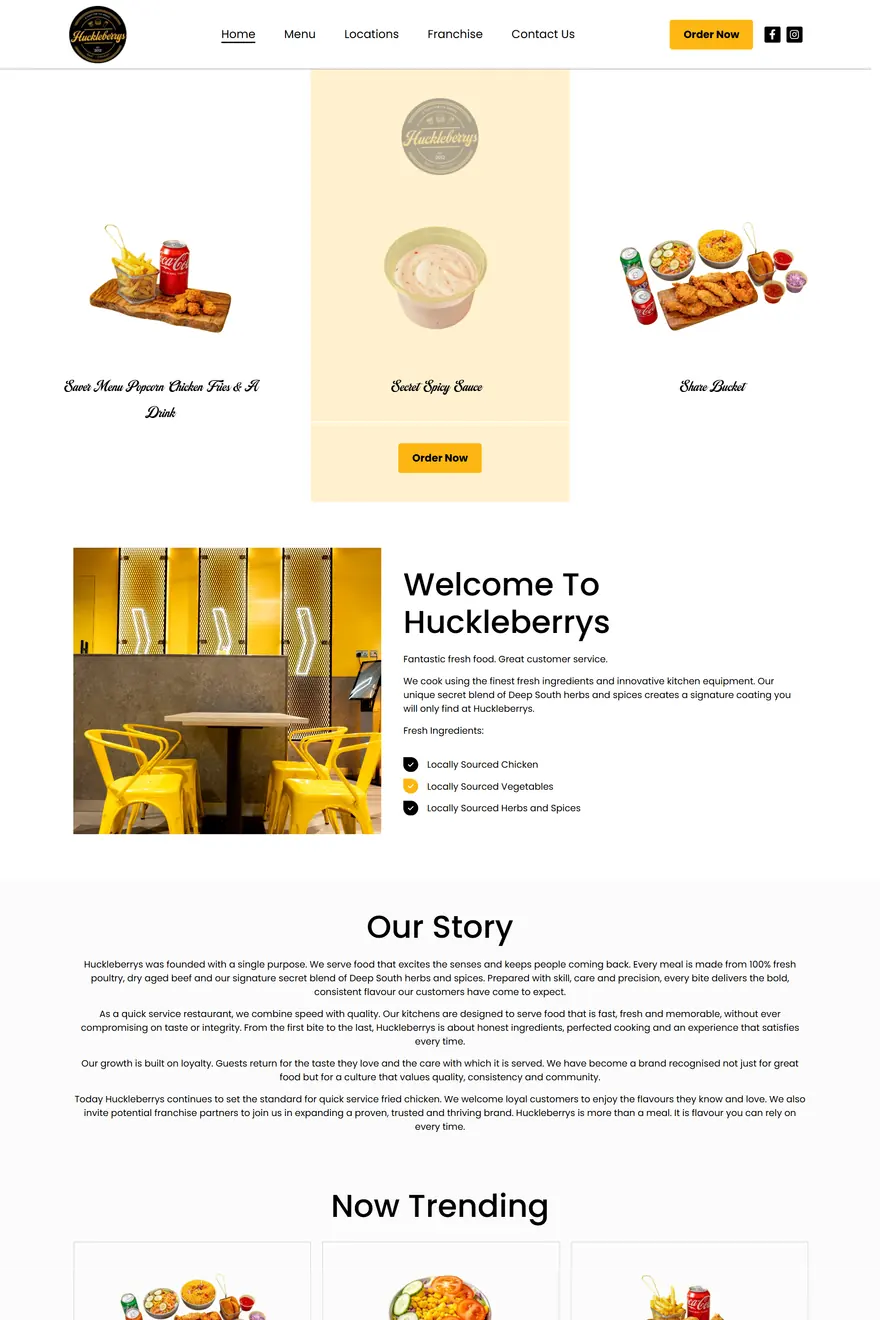
Live build — hover to pan
01
The Challenge
Restaurants live or die on local search. When someone nearby searches for a place to eat, the results they see are assembled from three sources: the website, the Google Business Profile, and the structured data that connects them. If those three disagree on the name, address, hours, or menu, search engines hedge, and the restaurant loses visibility to competitors whose signals are cleaner.
Huckleberry's Restaurant had a WordPress website, but the site was not doing that connective work. Pages were not structured around the local queries diners actually type, machine-readable data about the business was missing, and the website and Google Business Profile were not telling search engines the same story. The task was to turn the existing site into a coherent local search asset.
02
The Strategy
My strategy for local businesses starts from a simple rule: the website is the source of truth, and everything else must match it. So the first step was an audit of what the site said about the business versus what Google Business Profile said, and what neither said in a form search engines could parse. That produced a concrete list: which pages to optimize, which entities to mark up with schema, and which profile fields to align.
I prioritized the signals that matter most for a restaurant. Location and identity consistency came first, because it underpins every local ranking factor. On-page optimization came second, mapping real pages to real local intent. Schema markup came third, because structured data is how a restaurant tells Google its hours, cuisine, and location without ambiguity. Each layer builds on the one before it.
03
The Design
This project centered on optimization rather than a redesign, so design decisions served findability. A restaurant page has one job: let a hungry visitor confirm this is the right place and act. That means the essentials, location, hours, menu access, and contact, must be visible and consistent, because those are also the elements search engines extract and match against the Google Business Profile.
On restaurant projects I keep page structure deliberately simple. One clear heading hierarchy per page, content organized around what a diner asks before visiting, and no essential information buried in images or sliders where crawlers cannot read it. Clean structure is a design choice that pays out in both usability and rankings.
04
The Development
The site runs on WordPress, which is where I do most of my work, and the optimization was implemented in the build itself rather than bolted on. That means metadata written per page, heading structure corrected in the templates, internal links pointing local queries at the right pages, and schema markup added as structured JSON-LD rather than plugin defaults left on autopilot.
This is the difference between SEO as a service and SEO as engineering. When the markup, the metadata, and the page structure live in the site's code and configuration, they survive content updates and theme changes. I build WordPress sites this way from day one, and on existing sites like this one I retrofit the same standards.
05
The SEO
The SEO work had three threads. First, on-page optimization: page titles and meta descriptions rewritten around genuine local search intent, headings restructured so each page targets a distinct query, and internal linking arranged so authority flows to the pages that need to rank. Second, schema markup: restaurant-specific structured data covering the business identity, location, and operating details, so search engines read facts instead of inferring them.
Third, Google Business Profile alignment. I made the profile and the website consistent, the same name, address, and business details expressed the same way in both places, with the profile linking to the pages that answer the searcher's next question. For a local business this consistency is not cosmetic; it is the trust signal that local rankings are built on. The outcome of the engagement was improved search visibility for the restaurant's local queries.
06
The Performance
Local search rewards fast pages, because most diners search on phones, often on cellular connections, minutes before deciding where to go. My standard on WordPress projects is to treat Core Web Vitals as a requirement: compressed and properly sized images, no render-blocking excess, and a page weight that respects a mobile connection.
I verify rather than assume. Google Search Console and field data show how real visitors experience the site, and I use those tools to confirm that optimization work holds up outside the lab. A restaurant site that loads slowly at 7 p.m. on a Friday is failing at the exact moment it matters most, so that is the scenario I engineer for.
07
The Result
Huckleberry's Restaurant came out of the engagement with a WordPress site that works as a local search asset: pages optimized around real diner intent, restaurant schema in place, and a website and Google Business Profile that finally tell search engines one consistent story. Search visibility for the restaurant improved as those signals took effect.
Just as important is what the work leaves behind. Because the optimization is built into the site's structure, metadata, and markup rather than applied as a surface layer, it persists as the site is updated. That is the standard I hold on every project: the website itself should be the strongest SEO asset the business owns.
Services behind this project
Next Step
Have an idea for a website?
Let's turn it into something people remember — and search engines can understand.
Usually replies within a day · Lahore, Pakistan · working worldwide
View my work