
Case study — AI Tools · Content Platform
AI Tool Camp
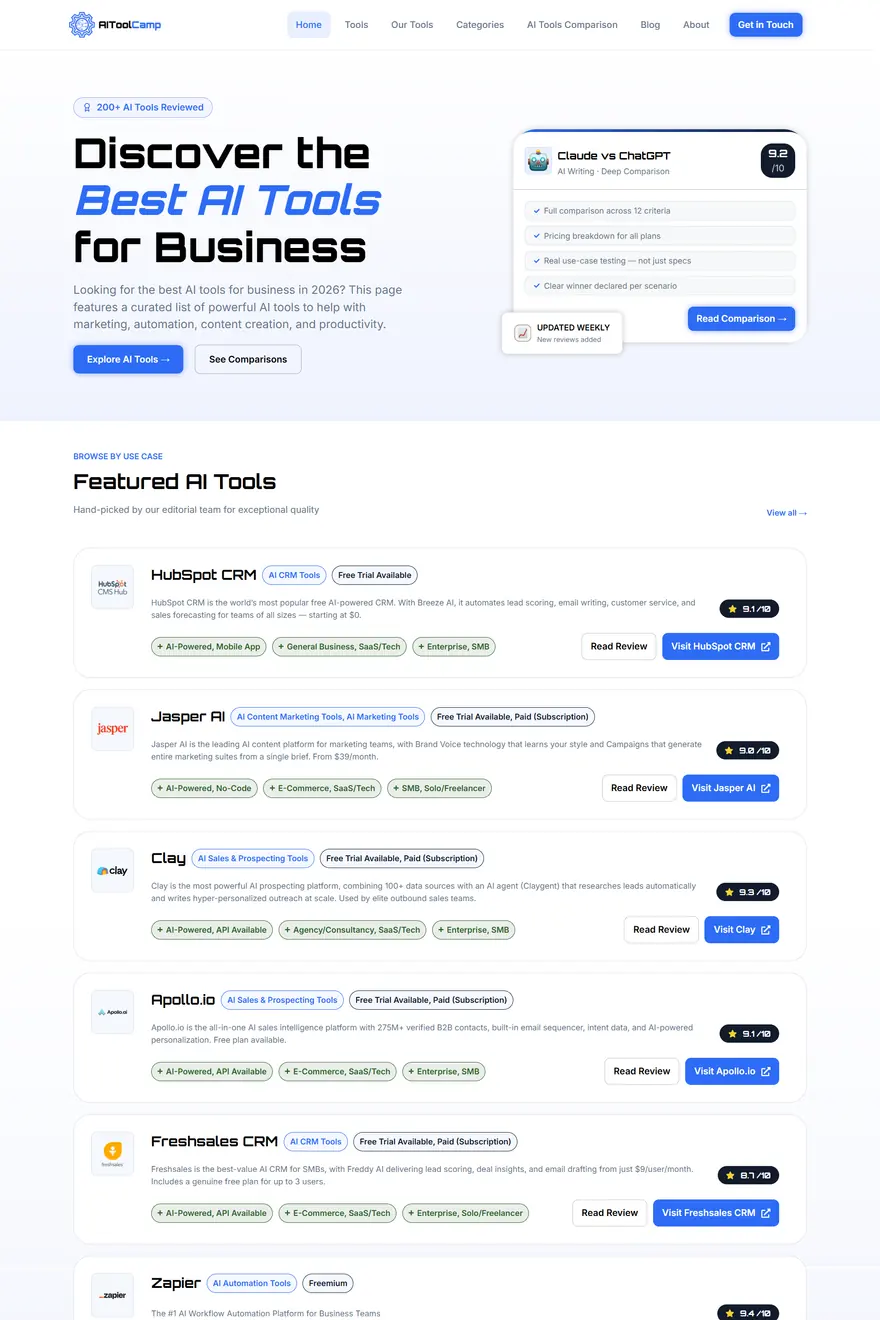
AI Tool Camp is a review platform covering AI tools, with a large article catalogue competing in a crowded, fast-moving niche. I ran a large-scale content and SEO program: keyword strategy, on-page optimization, and content structuring built to earn organic visibility across the whole catalogue, including AI-driven search surfaces.
- Role
- SEO & Content Architecture
- Services
- SEO Strategy · Content Structure · On-Page SEO
- Stack
- WordPress · GSC · Ahrefs
Live build — hover to pan
01
The Challenge
AI Tool Camp is a review platform covering AI tools. The category is crowded and it moves fast. New tools launch constantly, publishers chase the same keywords, and a large article catalogue is only an asset if search engines can understand it.
The real problem was scale. Optimizing one article is easy. Optimizing a large catalogue requires a system: consistent structure, a deliberate keyword map, and internal linking that tells search engines which page answers which query. My job was to build that system and apply it across the site.
02
The Strategy
I started with keyword strategy, not content edits. I mapped the catalogue against real search demand using SEMrush, Ahrefs, and Google Search Console data: tool-name queries, category queries, comparison queries, and informational questions. Each article was assigned a primary query and a clear intent, so no two pages competed for the same term.
Then I defined a repeatable on-page standard. At catalogue scale, one-off optimization does not hold up. A documented structure — how titles are written, how headings break down a review, where internal links point — means every article gets the same treatment and future content stays consistent.
03
The Design
My work on this project was content and search, so design here meant content design. A review page has one job: help a reader decide whether a tool fits, fast. That calls for a scannable structure — what the tool does, who it is for, pricing, strengths, limits — in a predictable order on every review.
That structure serves search as much as readers. Clear heading hierarchies and answer-shaped sections are exactly what search engines and AI assistants extract when they cite a source. On a platform like this, good content design and good SEO are the same discipline.
04
The Development
Development effort went where the SEO program needed it: clean, crawlable page structure at scale. That means valid heading hierarchies in the markup, schema markup for articles and reviews, and page structures that enforce the on-page standard instead of relying on editors to remember it.
On a catalogue this size, structure has to live at the template level, not in individual edits. When the standard is baked into how pages are built, every new article ships already optimized. That is my default approach on any large content build.
05
The SEO
On-page work covered the full catalogue: titles and meta descriptions rewritten against the keyword map, heading structures aligned to query intent, and content restructured so each article leads with the answer its target query is asking. I audited the site with Screaming Frog to surface duplication, thin sections, and orphaned pages, then fixed them systematically rather than page by page.
Internal linking carried the strategy. Reviews link to their category pages, comparisons link to the individual reviews they draw on, and informational articles funnel readers to the tools they discuss. I also structured content for AI search surfaces — direct answers near the top, clearly defined entities, explicit comparisons — because discovery in the AI tools niche increasingly happens through AI Overviews and assistants, not just traditional results.
06
The Performance
On a content site, speed is part of search. My standard is to hold every page against Core Web Vitals: fast initial render, stable layout while images and embeds load, and no scripts blocking the main content. A review platform lives or dies on how quickly an article becomes readable.
I monitor field data through Google Search Console rather than relying on one-off lab tests. Field data shows which pages real users experience as slow, and those pages get fixed first.
07
The Result
The engagement delivered a catalogue that works as a system rather than a pile of articles. Every page follows a defined on-page standard, targets a specific query, and connects to the rest of the site through deliberate internal linking. Schema and answer-first structure position the content for both traditional search results and AI-generated answers.
Just as important, the framework outlives the engagement. The keyword map and on-page standard give the platform a repeatable process for every new tool it covers, so the catalogue compounds instead of fragmenting. I do not publish traffic claims I cannot verify; what I can show is the method, and it is the same method I bring to every large content build.
Services behind this project
Next Step
Have an idea for a website?
Let's turn it into something people remember — and search engines can understand.
Usually replies within a day · Lahore, Pakistan · working worldwide
View my work