Case study — Financial Services
Citygate Financial Planning
Citygate Financial Planning needed a business website that could do what a financial firm's site must do: establish trust quickly, explain services clearly, and turn interest into enquiries. I built it as a WordPress site with a deliberate service architecture, a restrained professional design, and SEO-friendly development baked in from the first template.
- Role
- Website Development
- Services
- Business Website · Performance
- Stack
- WordPress · Elementor Pro
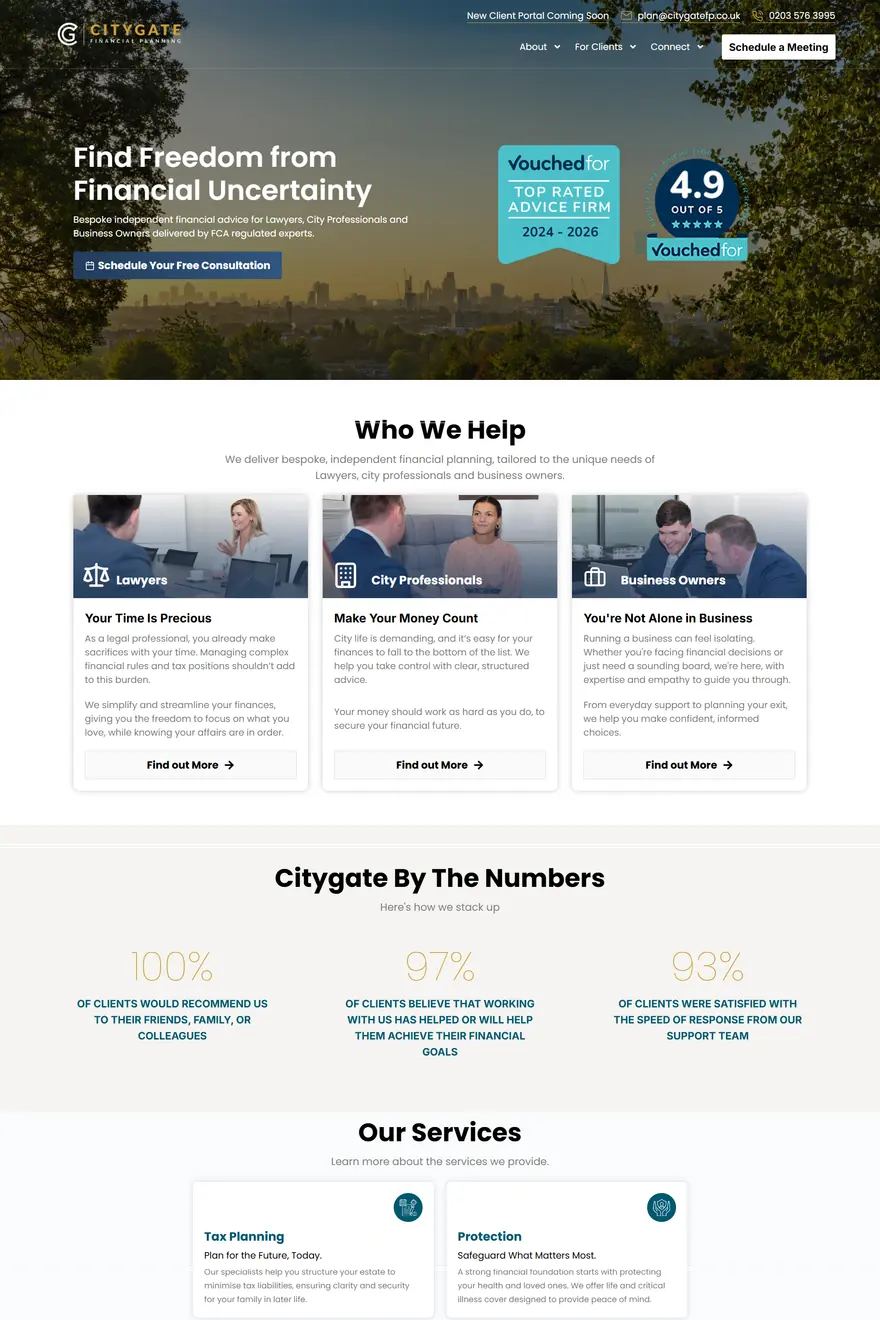
Live build — hover to pan
01
The Challenge
A financial planning firm sells trust before it sells anything else. Visitors arrive cautious. They are evaluating whether this is a firm they would hand their finances to, and they make that judgment in seconds, from the design, the clarity of the writing, and how easily they can find what the firm actually does. A site that looks generic or buries its services costs the firm enquiries it never sees.
The brief for Citygate Financial Planning was a business website built around exactly that problem: trust-first presentation, a clear service architecture, and a structure where every page moves a serious visitor toward making an enquiry. The site is not a brochure. It is the firm's first meeting with every prospective client.
02
The Strategy
I started with the service architecture, because in financial services that is the site. Each service needed its own clearly defined page rather than a single crowded list, so a visitor looking for one specific thing lands on a page about that thing. That structure serves people first, but it is also what search engines need: one page, one topic, one clear purpose.
The conversion model was deliberately quiet. Financial planning is not an impulse decision, so instead of aggressive pop-ups the strategy was a consistent, low-pressure path to contact: a visible enquiry route on every page, contact details that are easy to find, and copy that answers questions before asking for anything. The measure of success for a site like this is simple — does a qualified visitor know what the firm does and how to reach it.
03
The Design
The design language is restraint. Financial audiences read polish as competence and clutter as risk, so the layout relies on generous white space, a disciplined type hierarchy, and a limited, professional palette. Nothing on the page competes with the content; the firm's credibility is the visual message.
Every template was built responsive from the start. A large share of first visits to a local service business happen on a phone, so navigation, service pages, and enquiry forms were designed and tested at mobile sizes rather than adapted down from desktop as an afterthought.
04
The Development
I built the site on WordPress with Elementor, which gives the firm a professional custom interface and a back end its own team can update without a developer. The build is deliberately lean: only the plugins the site needs, reusable templates for service pages so the structure stays consistent as the firm grows, and clean, semantic markup underneath the page builder.
My standard deployment practice applied here as it does on every build: SSL/TLS configured correctly, scheduled backups, and security hardening at the server level. For a firm whose entire business is trust, a padlock in the address bar and a site that stays up are not optional details.
05
The SEO
SEO on this project was not a phase after launch; it was a property of how the site was built. The service architecture doubles as the keyword architecture — each service page targets the language a real client would search with. After the build I implemented on-page fundamentals across every page: titles and meta descriptions written for humans, a logical heading structure, and internal links that connect related services.
I added structured data so search engines understand the site as a business, not just a set of pages — organization details, services, and contact information marked up in schema. That groundwork is also what newer AI-driven search surfaces draw on, so the site is positioned for how people find firms now, not just how they did five years ago.
06
The Performance
Performance was treated as a trust signal, because for this audience it is one. A financial site that loads slowly reads as a firm that is careless with details. The build followed my standard Core Web Vitals discipline: compressed and properly sized images, no plugin bloat, caching configured at the server, and Elementor used with restraint so the page weight stays honest.
I verify this kind of build against Core Web Vitals thresholds rather than a subjective sense of 'feels fast.' Loading, interactivity, and layout stability are checked page by page, on mobile first, before the site is called done.
07
The Result
Citygate Financial Planning launched with a website that does its actual job: it presents the firm credibly, lays out every service on its own clear page, and gives a prospective client an obvious, low-friction way to enquire. The firm's team can maintain the content themselves, and the site runs on hardened, backed-up infrastructure.
Just as important is what the site is set up to do next. With Search Console and Analytics in place and the SEO groundwork built into the architecture, the firm can see how people find it and which services draw interest — and every future page inherits a structure that was engineered for search from day one.
Services behind this project
Next Step
Have an idea for a website?
Let's turn it into something people remember — and search engines can understand.
Usually replies within a day · Lahore, Pakistan · working worldwide
View my work